

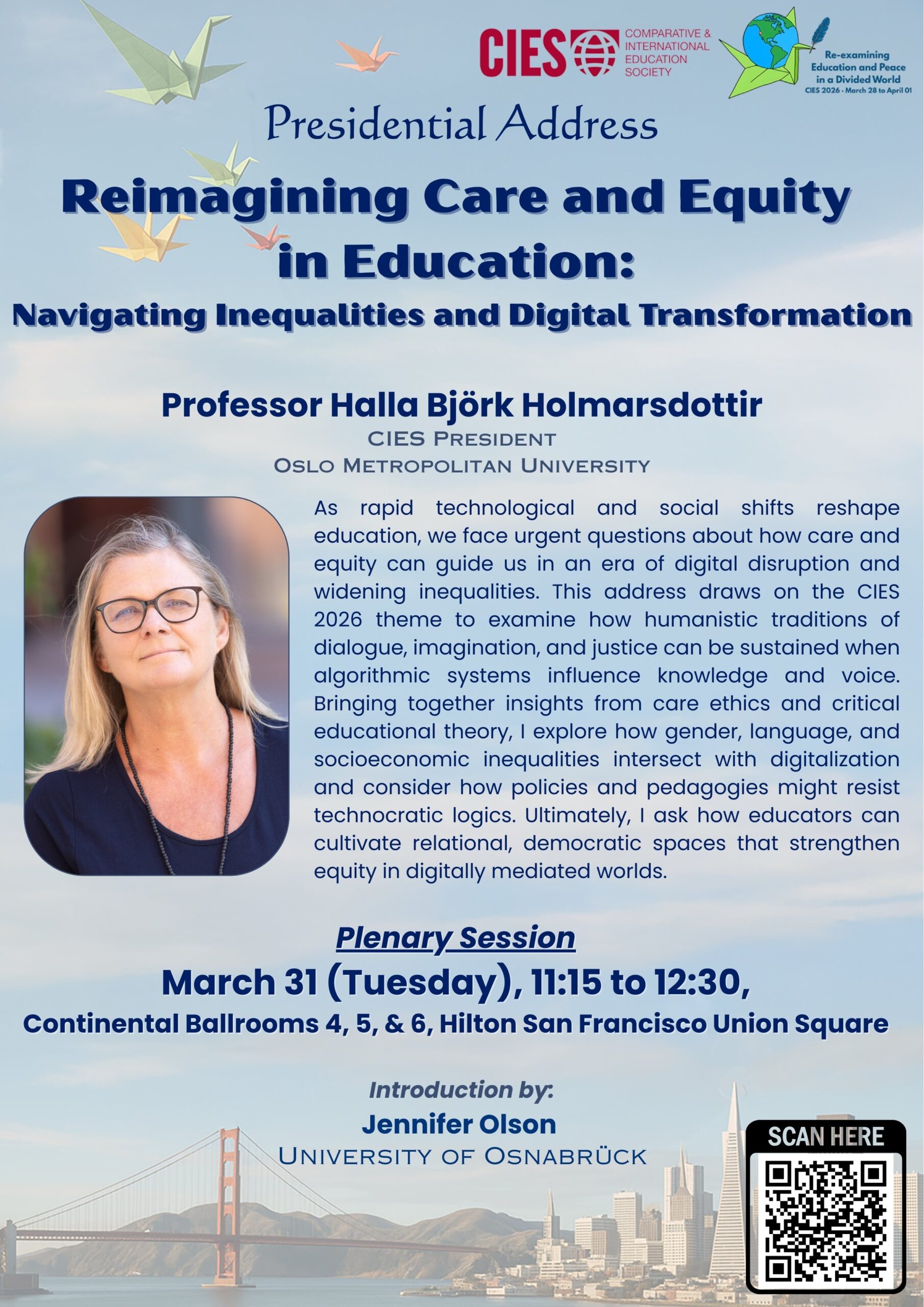
CIES Presidential Address
Reimagining Care and Equity in Education:
Navigating Inequalities and Digital Transformation
Professor Halla Björk Holmarsdottir
CIES President
Oslo Metropolitan University
Introduction by: Noah Sobe, UNESCO
As we navigate an era of profound technological and social transformation, education faces unprecedented challenges and possibilities. In my Presidential Address, I draw on the CIES 2026 theme, Re-examining Education and Peace in a Divided World, and ask: how can we reimagine care and equity as guiding principles for education in times of digital disruption and deepening inequality? What does it mean to uphold humanistic traditions—rooted in dialogue, imagination, and justice—when algorithmic systems increasingly shape what counts as knowledge and whose voices are heard? Can digital tools foster inclusion and agency, or do they risk reducing education to transactional metrics? To explore these questions, I examine the intersections of gender, language, and socioeconomic inequalities with the accelerating digitalization of learning, drawing on insights from care ethics and critical theories of education. I consider how frameworks from Noddings, Arendt, Freire, and hooks challenge us to resist technocratic logics and reclaim education as a relational, ethical practice. Finally, I ask: what policies and pedagogies can ensure that digital transformation strengthens rather than undermines equity, and how might educators cultivate spaces of care, responsibility, and democratic engagement in a world increasingly mediated by technology?
Halla B. Holmarsdottir is Professor of Comparative and International Education at Oslo Metropolitan University and President of the Comparative and International Education Society (CIES). Her research examines how children and young people navigate life in an increasingly digital society, with particular attention to the role of digital technologies and artificial intelligence in education, everyday life, and young people’s understandings of their futures. Her work foregrounds questions of equity, social inclusion, democratic participation, and the persistent gap between educational policy and practice.
A former Vice-Dean of Research at OsloMet’s Faculty of Education and International Studies, Halla has extensive experience leading international and interdisciplinary research teams. She served as the Scientific Coordinator for DigiGen, a major Horizon 2020 project investigating technological transformations and their implications for the digital generation, and she currently contributes to the Horizon Europe project STRIDE – Strategies for achieving equity and inclusion in education, training and learning in democratic Europe (2023–2027). Her scholarship draws on ethnographic and mixed-methods approaches to illuminate how digitalisation shapes childhoods, learning environments, family life, and wellbeing.
Halla has published widely and co-edited volumes on digital wellbeing, parental mediation, and competencies for inclusive and sustainable futures, including the recent open-access book Understanding the Everyday Digital Lives of Children and Young People (Palgrave 2024). She is also deeply committed to mentoring emerging scholars and strengthening global research networks that support inclusive and context-sensitive educational futures.