
KEYNOTE SPEAKERS
The Comparative and International Education Society (CIES) is honored that Professor Mark Bray will deliver the Kneller Lecture and Professor Monisha Bajaj will deliver the Keynote Address at CIES 2026.
Kneller Lecture
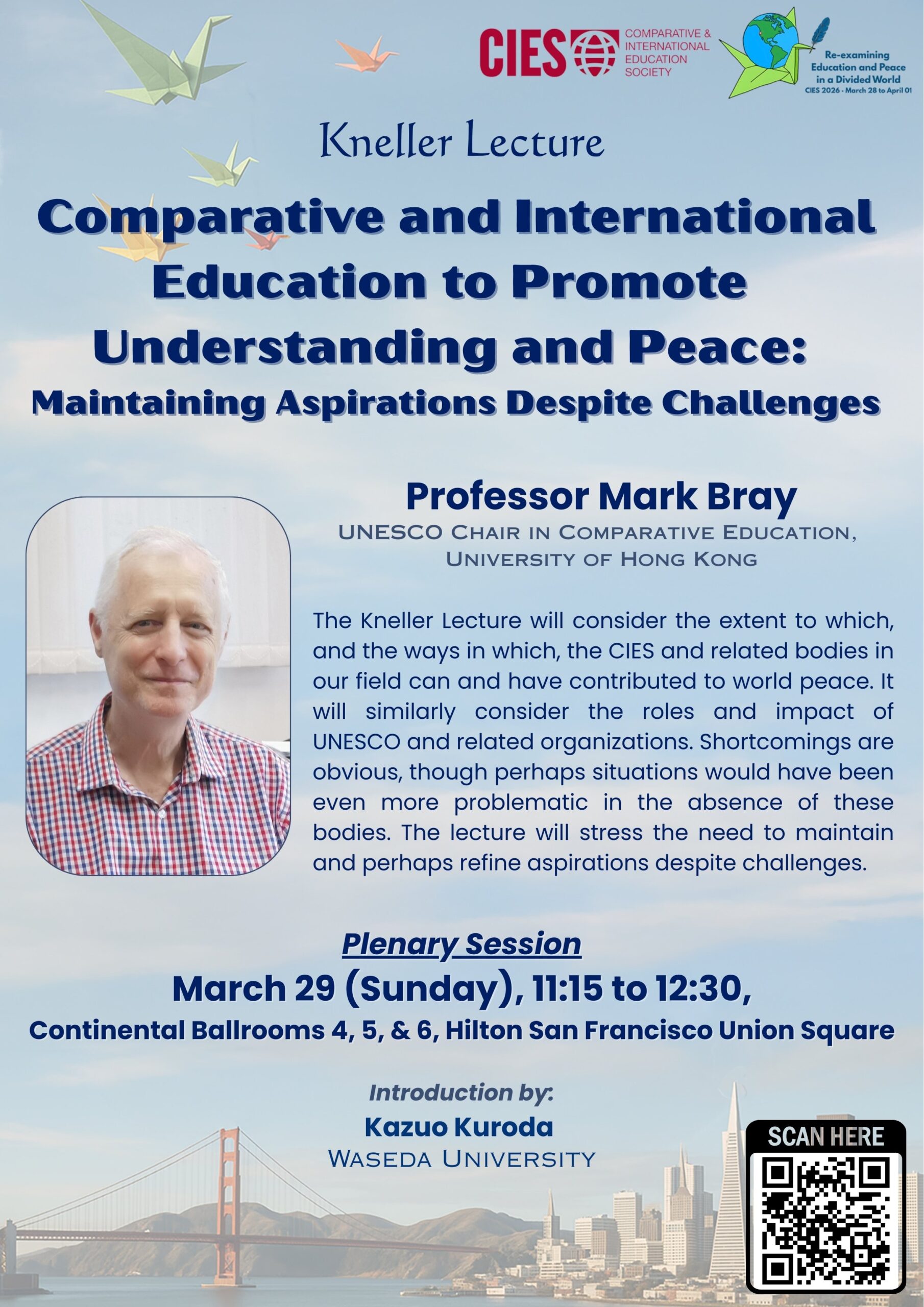
Comparative and International Education to Promote Understanding and Peace: Maintaining Aspirations Despite Challenges Professor Mark Bray
Our 2026 conference marks the CIES 70th anniversary. It also marks the 80th anniversary of ratification of the UNESCO Constitution, and is held in the city where the United Nations was founded in 1945.
The Constitution of what was then the Comparative Education Society (i.e. before the addition in 1968 of International) had a pre-history linked to World War II. The society’s origins lay in study tours to diverse countries organized by the founding leadership to promote international understanding and peace. The society’s Constitution to some extent reflects this goal. Even more explicit are the Statutes of the World Council of Comparative Education Societies (WCCES), of which the CIES was a founding member in 1970. These Statutes include the goal “to advance education for international understanding in the interests of peace, intercultural co-operation, mutual respect among peoples and observance of human rights”. They are consistent with the evocative phrase of UNESCO’s Constitution “That since was begin in the minds of men, it is in the minds of men that the defences of peace must be constructed”.
Experience has shown that these aspirations are not simple. More education and international communication do not necessarily enhance understanding and peace, and indeed education can be a tool for indoctrination and divisiveness. Further, academic researchers, who comprise the largest proportion of CIES members, may not have international understanding and peace at the top of their personal agendas and career plans.
In the 1960s, George Kneller, whose bequest supports this lecture, critiqued much work in comparative education as “inept” and needing conceptual refinement with improved practicality. We have come far since that era, but still need to confront inadequacies. This lecture will argue that the goal of international understanding and peace remains highly desirable for our field, and will urge maintenance of aspirations despite the challenges.
Professor Mark Bray holds the UNESCO Chair in Comparative Education at the University of Hong Kong. He is a past-President of the CIES, the World Council of Comparative Education Societies (WCCES), and the Comparative Education Society of Hong Kong (CESHK). He is also a member of the Board of Directors of the Comparative Education Society of Asia (CESA).
Professor Bray commenced his career as a secondary-school teacher in Kenya and Nigeria, before proceeding to postgraduate studies and then teaching at the Universities of Edinburgh, Papua New Guinea and London. In 1986 he moved to the University of Hong Kong where, among other roles, he co-founded the Comparative Education Research Centre. Between 2006 and 2010
he took leave to work in Paris as Director of UNESCO’s International Institute for Educational Planning (IIEP). He has also undertaken assignments for the Asian Development Bank, the Commonwealth Secretariat, UNICEF, UNDP, and the World Bank.
Keynote Address
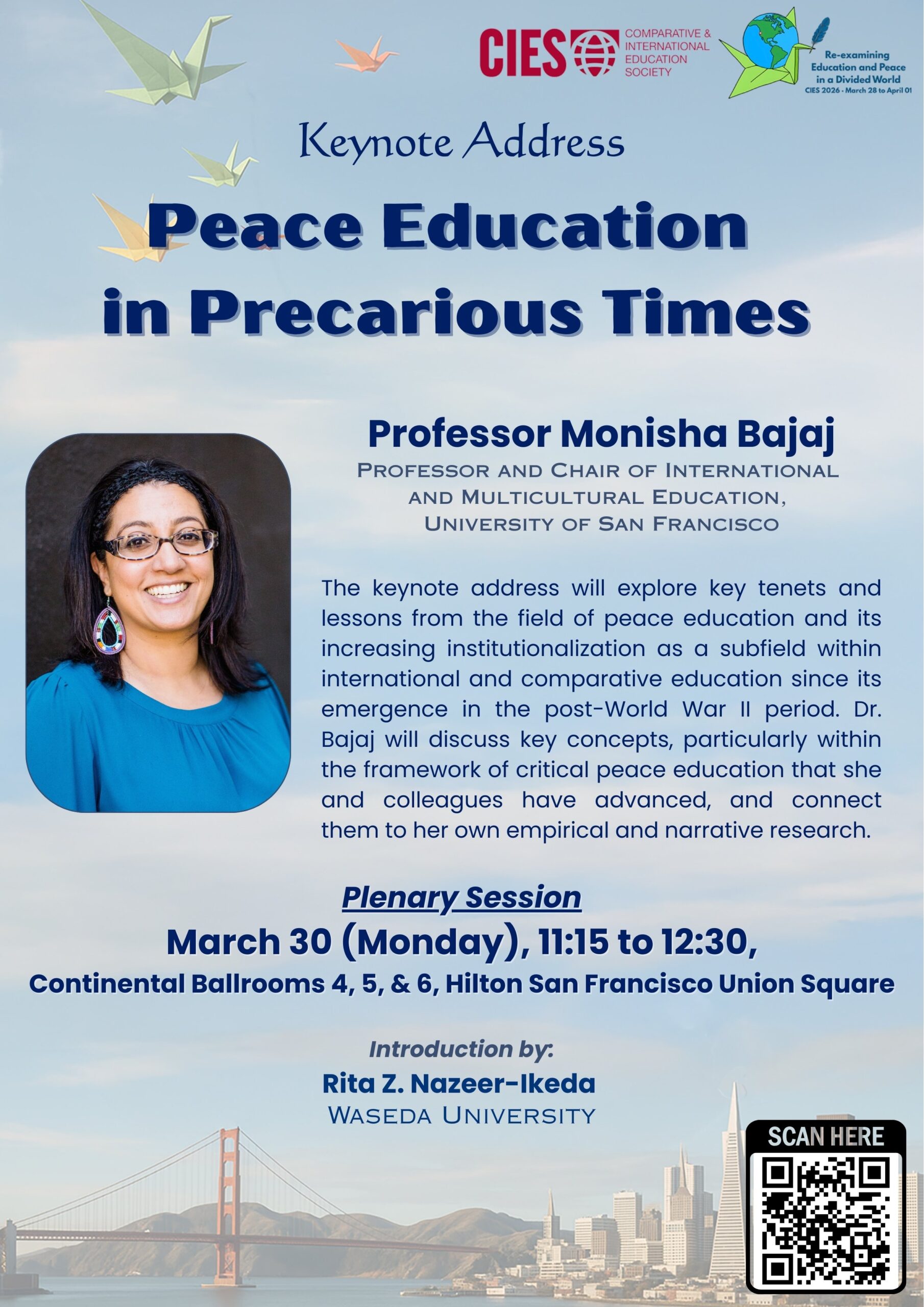
Peace Education in Precarious Times Professor Monisha Bajaj
Since World War II, peace education has emerged as a field of study, policy, and practice alongside and within the field of international and comparative education and in the realm of global policy. The Comparative and International Education Society was formally chartered 70 years ago in 1956, and the Peace Education Commission within the International Peace Research Association soon after in 1964. How has peace education research and praxis shaped the field of international and comparative education? What insights can peace education—particularly in its critical and decolonial approaches—offer in the present moment for scholars and practitioners in global education? What is the role of peace education in an increasingly violent and unequal world? With rising authoritarianism and disregard for international human rights frameworks, conventional notions of liberal peace are being challenged; how can education respond to this time of polycrisis?
This keynote lecture explores these questions and the lessons peace education might offer for the precarious times we find ourselves in. Focusing on the conference theme of “Re-examining Education and Peace in a Divided World,” Monisha Bajaj will discuss core concepts from critical peace education, namely: the role of student and educator agency in transforming unequal systems; the centrality of human dignity in education for peace; the ethic of justice in our work as scholars and practitioners; and the epistemic requirement of solidarity. Dr. Bajaj’s keynote will also offer insights from her nearly three decades of research and engaged praxis across the globe.
Dr. Monisha Bajaj is Professor and Chair of International and Multicultural Education at the University of San Francisco. She is the editor and author of eight books and numerous articles on issues of peace, human rights, migration, racial justice, sustainability, and education, as well as the founding editor-in-chief of the International Journal of Human Rights Education. Dr. Bajaj has developed curriculum and teacher training materials for non-profit and national advocacy organizations as well as inter-governmental organizations, such as UNICEF, UNESCO, and Global Kids.
Dr. Bajaj’s research has been supported by the U.S. Fulbright Program, the Social Science Research Council, the National Academy of Education, the Spencer Foundation, the University of San Francisco’s Jesuit Foundation, and the Rockefeller Foundation’s Bellagio Center, among others. Her 2012 book, Schooling for Social Change: The Rise and Impact of Human Rights Education in India (Bloomsbury), was awarded the Jackie Kirk Outstanding Book Award from the Comparative and International Education Society. In 2015, Dr. Bajaj was awarded the Ella Baker/Septima Clark Human Rights Award (2015) from Division B of the American Educational
Research Association (AERA) and the Teachers College, Columbia University Early Career Distinguished Alumni Award. She also received the Distinguished Research Award from the University of San Francisco in 2018. Her co-edited (with Janelle Scott) World Yearbook of Education 2023: Racialization and Educational Inequality in Global Perspective (Routledge) won the 2023 Critics’ Choice Book Award from the American Educational Studies Association.
Seeking to translate her work for wider audiences, Dr. Bajaj has contributed widely-read guest articles for the Global Partnership for Education, Learning for Justice, The Conversation, and Edutopia. Her debut picture book is entitled “A Year of Kites,” and—with vibrant illustrations by Amber Ren—chronicles kite-flying traditions from around the globe. More information about Dr. Bajaj’s work can be found at www.monishabajaj.net .
| Saturday, March 28 |
Sunday, March 29 |
Monday, March 30 |
Tuesday, March 31 |
Wednesday, April 01 |
|
|---|---|---|---|---|---|
| 11:15 to 12:30 | Kneller Lecture (Plenary) [CIE to Promote Understanding & Peace] |
Keynote Address (Plenary) [Peace Education in Precarious Times] |
|||
| 13:15 to 14:30 | Symposium 2 (Plenary) [Looking Back to Go Forward] |
Symposium 4 (Plenary) [Learning & Its Centrality to Peace] |
Symposium 7 (Plenary) [Beyond the Binary of Conflict & Peace] |
||
| 14:45 to 16:00 | Symposium 3 [Peace as an Ideal for Transforming Education] |
Symposium 5 [Comparative Education, Conflict, & Peace Education] |
Symposium 8 [What Will Be Lost with the Closure of USAID?] |
||
| 16:30 to 17:45 | Symposium 1 [International Preventive Diplomacy as Preventive Education for Peace] |
Symposium 6 [Educating & Organizing for Peace & Justice] |
All plenary sessions are scheduled without parallel concurrent sessions