
International education has long been shaped by the principle of peace, from early efforts under the League of Nations to postwar initiatives led by UNESCO and the Fulbright Program, which framed international education as a means to humanize international relations. Over time, “International Education for Peace” became a global norm in educational policy and practice. After the Cold War, conflicts increasingly rooted in ethnic, religious, and historical divisions reinforced the importance of education for social cohesion and reconciliation. This commitment was reaffirmed in global frameworks such as the 2015 Sustainable Development Goals, particularly SDG 4.7, and the 2023 UNESCO Recommendation on Education for Peace, Human Rights and Sustainable Development. However, these initiatives have largely remained normative and have not evolved into a robust policy framework for preventive diplomacy. Limited theoretical and empirical research has further raised doubts about their effectiveness. At CIES 2026, we revisit International Education for Peace to critically examine its mechanisms and evidence, and to propose meaningful contributions to post-2030 global education governance.
Introductory Address
Kazuo Kuroda
CIES President-Elect (2025-2026)
Professor, Waseda University
Kazuo Kuroda is Professor at the Graduate School of Asia-Pacific Studies, Waseda University, Visiting Research Fellow at the JICA Ogata Sadako Research Institute for Peace and Development, and President-elect of the Comparative and International Education Society (CIES). His research focuses on international education development in Asia, global and regional governance of education, and the internationalization of higher education. He holds degrees from Waseda University (B.A.), Stanford University (M.A.), and Cornell University (Ph.D.). His career includes positions at the Overseas Development Council, the World Bank, Hiroshima University, and Waseda University. His recent publications include A History of Japan’s International Cooperation in Education (2023) and Sustainable Development Disciplines for Humanity (2023).
Invited Speakers
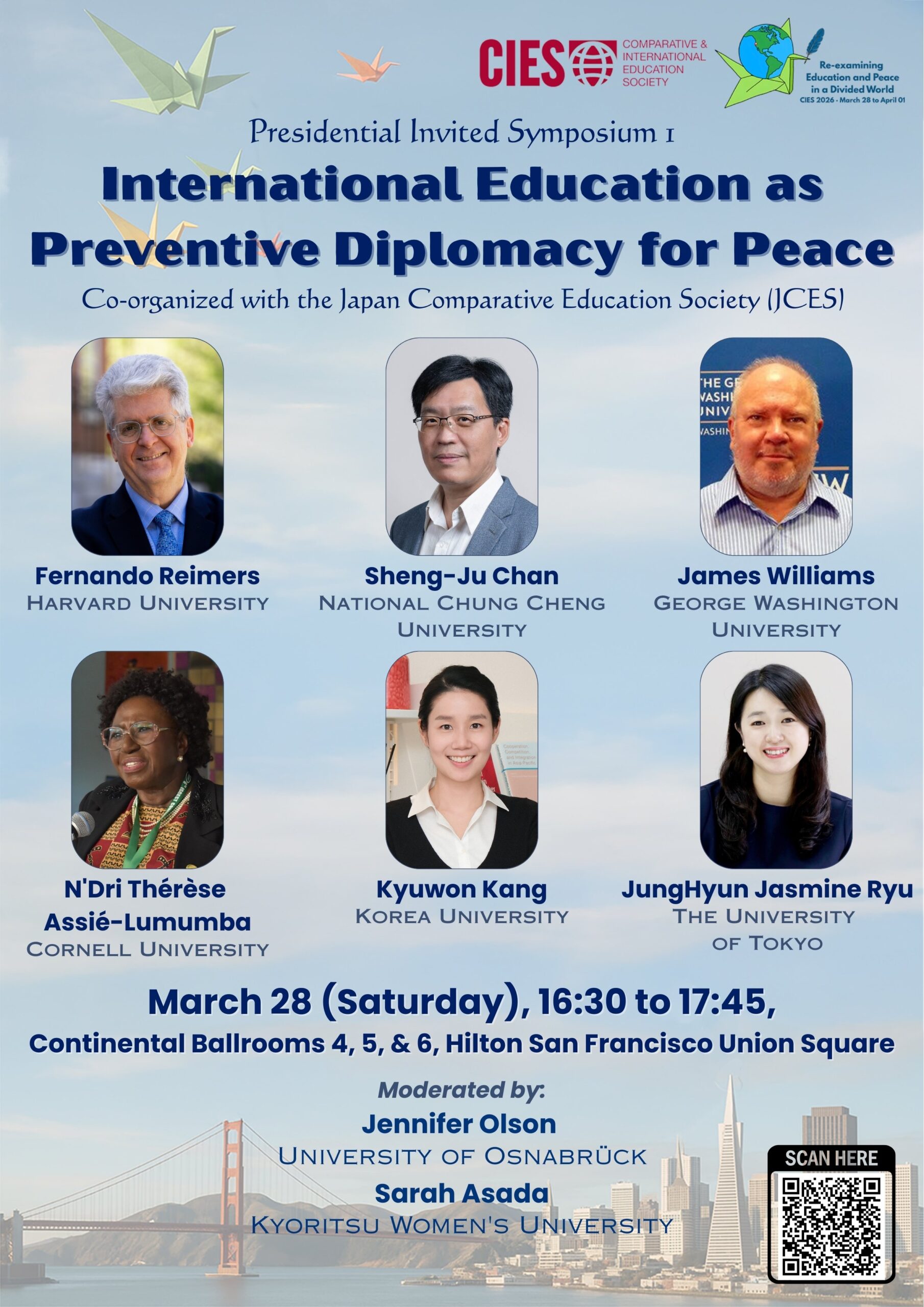
Fernando M. Reimers
Global Citizenship Education, Rising Nationalism, and Peace
Fernando Reimers is the Ford Foundation Professor of International Education and an expert in global education. He is a member of the US National Academy of Education and served on UNESCO’s Commission on the Futures of Education. Reimers has developed curricula aligned with the UN Sustainable Development Goals and has authored or edited 56 books of which the most recent is ‘Artificial Intelligence and Education in the Global South’. His work focuses on preparing youth to thrive in the 21st century.
Sheng-Ju Chan
Reframing Education Diplomacy: Peace, Soft Power, and the Taiwanese Experience
Dr. Sheng-Ju Chan is a Distinguished Professor at the Graduate Institute of Education and Vice President of National Chung Cheng University, Taiwan. He is currently President of the Taiwan Higher Education Society and has also served as President of the Chinese Taipei Comparative Education Society. Internationally, Professor Chan serves as Associate Editor of the International Journal of Educational Development and is a member of the Editorial Advisory Board of Higher Education Research and Development.
James H Williams
Two Faces of Education and Peace
James H Williams, Ed.D., is an emeritus professor of International education and international affairs and a former UNESCO Chair of International Education for Development at George Washington University. His research interests relevant to the symposium: Relationships among education, peace, and conflict; Teaching and learning of difficult history; Role of school textbooks in shaping collective narratives and identities. In this context, he has examined Sri Lanka, Malaysia, Cambodia, and the Philippines and edited/co-edited three books of national cases on textbooks, national identity, and conflict.
N’Dri Thérèse Assié-Lumumba
Reclaiming Humanity through uBuntu-based Education: Pathways to Collective Survival in a Globalized and Hyperconnected World
N’Dri ASSIÉ-LUMUMBA, with a PhD in Comparative Education from the University of Chicago, is a Professor of African, African Diaspora and Comparative/International Education in Africana Studies and Research Center at Cornell University. She is Distinguished Visiting Professor at the University of Johannesburg, President of Global Africa-CIES, and Fellow of the World Academy of Art and Science. Her past leadership positions include as Director of Cornell Institute for African Development, President of CIES and WCCES, Chair of the Scientific Advisory Committee (SAC) of UNESCOS’s MOST program. She held other distinguished positions in Africa and globally with numerous awards and has published on higher education, ICT, gender/equity, indigenous knowledge systems, and uBuntu.
Kyuwon Kang
Korea’s International Education for Preventive Diplomacy: Policy Shifts in Government Scholarship Programs
Kyuwon Kang is an Associate Professor at the Graduate School of International Studies, Korea University. She worked as a researcher at the Korea International Cooperation Agency and served as a research assistant at the Japan International Cooperation Agency Research Institute. Her research focuses on the regionalization of higher education in East Asia, as well as the effectiveness of educational aid projects and global citizenship education. She holds a B.A. from Cornell University and a M.A. and Ph.D. from Waseda University.
JungHyun Jasmine Ryu
Bridging Divides through Education: Rethinking Global Engagement for a More Peaceful Future
Dr. Ryu is a scholar-practitioner in international higher education whose research explores inclusive internationalization, transnational mobility, and peace education. She has worked at universities across Japan, Korea, Vietnam, and the United States. Currently leading the international exchange division at the University of Tokyo’s Center for Global Education, her work bridges practice and peace-oriented scholarship, advocating for responsible academic partnerships that foster global citizenship and equitable internationalization.
Co-Moderators
Jennifer Olson is a lecturer at the University of Osnabrück, Germany, specializing in higher education internationalization and governance. She also serves as a Senior Program Coordinator for the Comparative and International Education Society (CIES) 2026 Conference. With more than 20 years of experience as a scholar–practitioner in international education, Jennifer has held a range of roles, including consultant for RTI International, postdoctoral researcher at the University of Oslo, and Fulbright Fellow.
Sarah R Asada is a Professor at Kyoritsu Women’s University in Tokyo, Japan. An award-winning researcher and educator, she focuses on diplomacy, peace, and education, with expertise in internationalization, international cooperation, and diversity and inclusion. A comparativist whose work spans Asia, Europe, and North America, Sarah’s current research examines the intercultural dimensions of peacebuilding and diplomacy through six decades of Japan–U.S. educational exchange. Bridging research and practice, she collaborates with UNESCO, the JICA Ogata Research Institute, and community organizations.
Organizer
Kazuo Kuroda
| Saturday, March 28 |
Sunday, March 29 |
Monday, March 30 |
Tuesday, March 31 |
Wednesday, April 01 |
|
|---|---|---|---|---|---|
| 11:15 to 12:30 | Kneller Lecture (Plenary) [CIE to Promote Understanding & Peace] |
Keynote Address (Plenary) [Peace Education in Precarious Times] |
|||
| 13:15 to 14:30 | Symposium 2 (Plenary) [Looking Back to Go Forward] |
Symposium 4 (Plenary) [Learning & Its Centrality to Peace] |
Symposium 7 (Plenary) [Beyond the Binary of Conflict & Peace] |
||
| 14:45 to 16:00 | Symposium 3 [Peace as an Ideal for Transforming Education] |
Symposium 5 [Comparative Education, Conflict, & Peace Education] |
Symposium 8 [What Will Be Lost with the Closure of USAID?] |
||
| 16:30 to 17:45 | Symposium 1 [International Preventive Diplomacy as Preventive Education for Peace] |
Symposium 6 [Educating & Organizing for Peace & Justice] |
All plenary sessions are scheduled without parallel concurrent sessions