
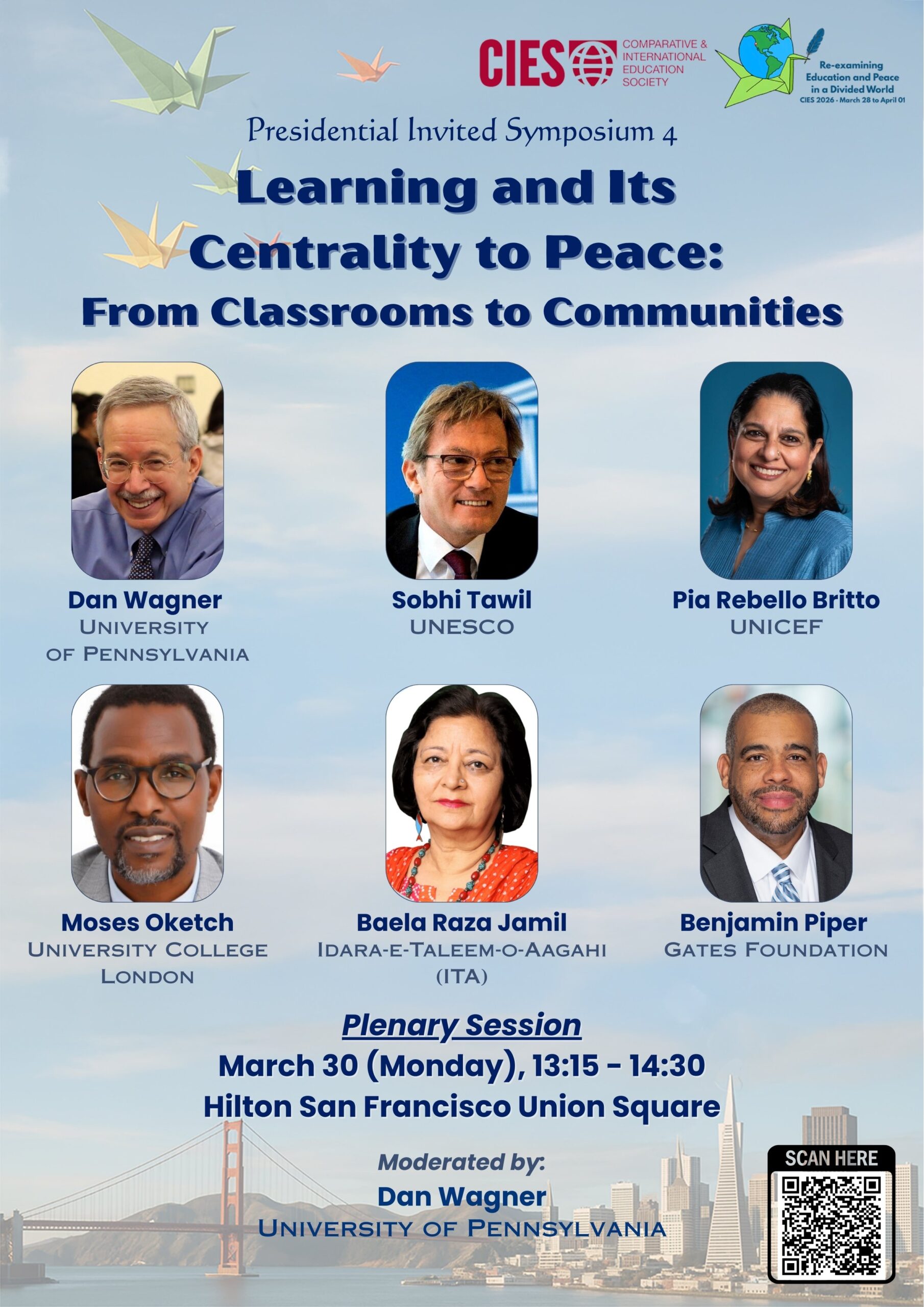
In 1996, UNESCO’s Jacques Delors wrote in Learning: The Treasure Within that education must foster not only knowledge, but also understanding, tolerance, and democratic citizenship. He underscored that education is key to resolving conflicts by deepening mutual understanding and promoting peace. The 2015 UN Sustainable Development Goals reaffirmed this vision by highlighting the role of quality learning in strengthening citizenship, justice, social cohesion, and sustainable development. Yet, in today’s increasingly multipolar world—marked by rapid technological change, including AI, the pervasive influence of social media, rising polarization, and intensifying threats to democracy—the question becomes even more urgent: whether, and in what ways, education can actively promote peace in classrooms, communities, and countries. This panel will examine a range of contexts and societies to explore how efforts to expand equitable and inclusive learning may contribute to building a more stable and peaceful world.
Invited Plenary Speakers
Dan Wagner is the UNESCO Chair in Learning and Literacy, and Professor of Education at the University of Pennsylvania. He is Founding Director of the International Literacy Institute, co-established by UNESCO and the University of Pennsylvania, Founding Director of the US National Center on Adult Literacy, and PennGSE’s International Educational Development Program. Dr. Wagner has served as an advisor to UNESCO, UNICEF, World Bank, USAID, DFID, and others. He is the 2021 recipient of the CIES Honorary Fellow Award.
Pia Rebello Britto is the Global Director for Education and Adolescent Development at UNICEF, providing strategic leadership to expand children’s access to quality learning. She guides global policies, programmes, and partnerships in education and adolescent development. Previously, she served as UNICEF Representative to the Lao People’s Democratic Republic and as Global Chief of Early Childhood Development. She holds a doctorate in developmental psychology and is widely recognized for her expertise on early childhood, equity, and systems-level reform in education worldwide.
Moses Oketch is Professor of Comparative and International Education at University College London (UCL) with expertise in education economics, policy, and systems in low- and middle-income countries. His research focuses on equity, access, and financing of education, including learning outcomes and youth transitions. He has held advisory roles with UNESCO, UNICEF, the World Bank, and national governments, contributing to policy development and evaluation. Oketch’s work bridges rigorous research with practical policy impact across global education agendas.
Baela Raza Jamil is a public policy specialist and former Technical Adviser to Pakistan’s Federal Ministry of Education. She is CEO of Idara-e-Taleem-o-Aagahi (ITA) and founder of the Children’s Literature Festival/Pakistan Learning Festival. She has led nationwide movements advancing early childhood education, girls’ education, second-chance programs, and ASER Pakistan since 2008. ASER serves as a public good informing policy and sector planning. She also spearheaded Pakistan’s first Education Parliamentarians Caucus, launched on the International Day of Education in 2022.
Benjamin Piper is Director, Global Education at the Gates Foundation. Based in the foundation’s Nairobi office, Benjamin supports grantees that work to improve foundational literacy and numeracy in low- and middle-income countries. Benjamin has a doctorate in international education from the Harvard Graduate School of Education and master’s degrees in international education policy and school leadership from the Harvard Graduate School of Education and Furman University, respectively. He has lived in East Africa since 2007.
Discussant
Amrit Thapa
Organizer & Moderator
Dan Wagner
| Saturday, March 28 |
Sunday, March 29 |
Monday, March 30 |
Tuesday, March 31 |
Wednesday, April 01 |
|
|---|---|---|---|---|---|
| 11:15 to 12:30 | Kneller Lecture (Plenary) [CIE to Promote Understanding & Peace] |
Keynote Address (Plenary) [Peace Education in Precarious Times] |
|||
| 13:15 to 14:30 | Symposium 2 (Plenary) [Looking Back to Go Forward] |
Symposium 4 (Plenary) [Learning & Its Centrality to Peace] |
Symposium 7 (Plenary) [Beyond the Binary of Conflict & Peace] |
||
| 14:45 to 16:00 | Symposium 3 [Peace as an Ideal for Transforming Education] |
Symposium 5 [Comparative Education, Conflict, & Peace Education] |
Symposium 8 [What Will Be Lost with the Closure of USAID?] |
||
| 16:30 to 17:45 | Symposium 1 [International Preventive Diplomacy as Preventive Education for Peace] |
Symposium 6 [Educating & Organizing for Peace & Justice] |
All plenary sessions are scheduled without parallel concurrent sessions