
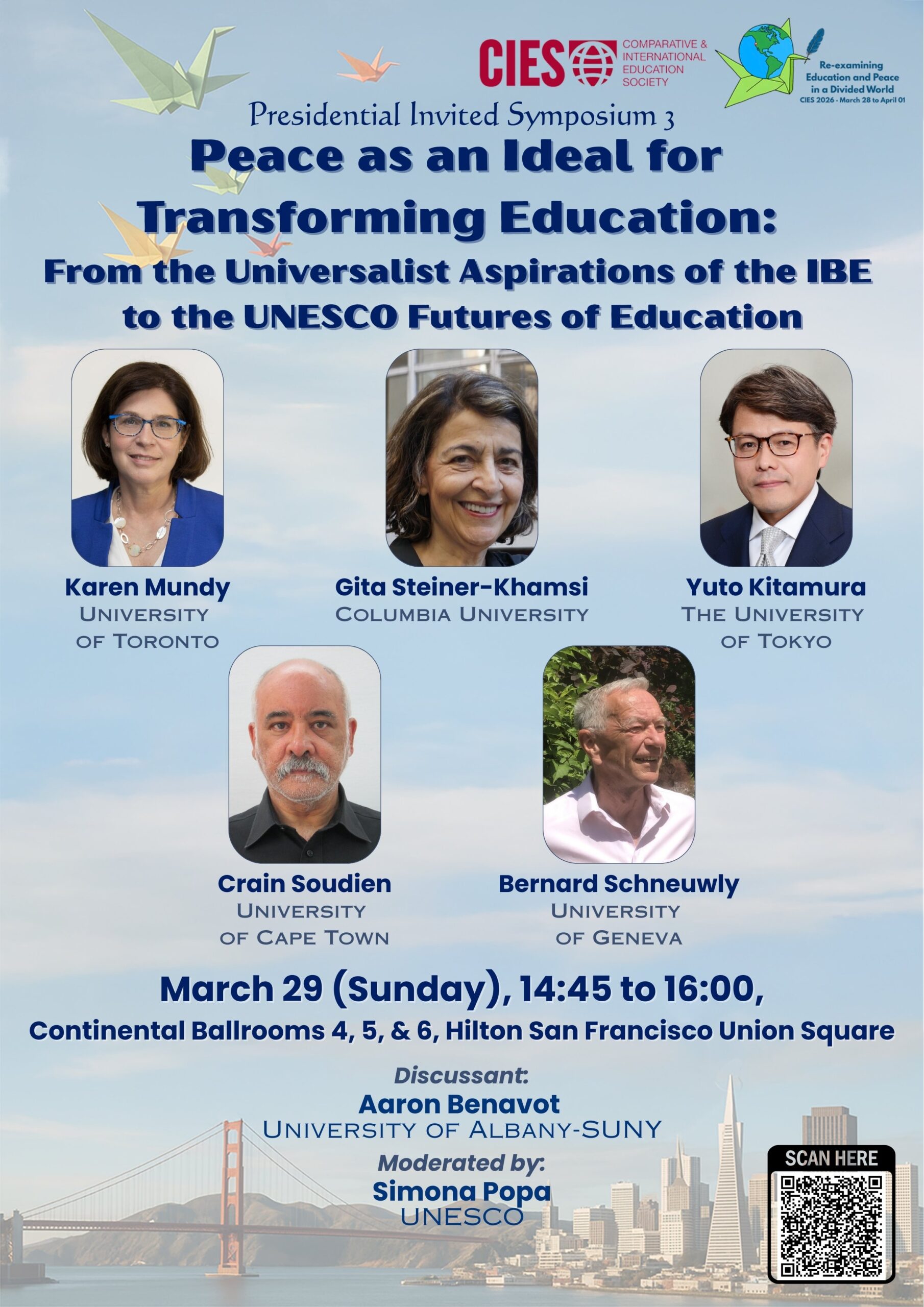
This Presidential Panel explores the long-held belief that international cooperation in education is key for global peace. Rooted in the early efforts of the International Bureau of Education (IBE) and later UNESCO, this conviction grew stronger after World War II, when education was seen as a moral force for rebuilding a shared humanity. Today, however, rising conflicts, democratic backsliding, polarization, and widening inequalities make this faith feel both urgent and increasingly fragile.
The panel examines why the influence of education on political and violent conflict has often been limited, reversible, or misunderstood, and whether assumptions about “education for peace” need to be reconsidered. Bringing together leading scholars, it traces how visions of peace in education have evolved, from civics education to global citizenship, and links these histories to recent initiatives such as the UN Transforming Education Summit and UNESCO’s Futures of Education. The panel argues for reclaiming peace as an everyday practice that upholds human dignity and enables the imagining of shared, though often contested, futures.
Invited Speakers
Karen Mundy is a Professor of Educational Leadership and Policy at the Ontario Institute for Studies in Education, University of Toronto. A leading expert on education in the developing world, education policy, and international organizations, she has served as Chief Technical Officer of the Global Partnership for Education, Director of UNESCO’s IIEP, and President of the Comparative and International Education Society. She is the author of six books and over 60 articles, a two-time Bereday Award recipient, and a member of the UNESCO Futures of Education Commission.
Gita Steiner-Khamsi is Professor at Columbia University and Honorary UNESCO Chair in Comparative Education Policy at the Geneva Graduate Institute. She serves as Senior Adviser for NORRAG and is a past president of the Comparative and International Education Society (CIES). Her research focuses on comparative education policy, policy borrowing and transfer, and global governance, with a geographic focus on Mongolia and Central Asia. She has published sixteen books, numerous articles, and held visiting appointments at Aarhus, Humboldt, Stanford, and Oslo universities.
Yuto Kitamura is a Professor at the Graduate School of Education and a Special Advisor to the President, The University of Tokyo. He received his Ph.D. in Education from UCLA and an honorary doctorate from Stockholm University. He was a Fulbright Scholar at the George Washington University and has served as a Special Advisor to the Rector of the Royal University of Phnom Penh in Cambodia. His research focuses on education policy in developing countries, particularly in Southeast Asia.
Crain Soudien is Honorary Professor at Nelson Mandela University and a former CEO of the Human Sciences Research Council, South Africa. He previously served as Deputy Vice-Chancellor at the University of Cape Town, where he remains a professor in the School of Education. His research focuses on social difference, culture, education policy, comparative education, educational change, and public history. He has authored over 250 publications and serves on numerous academic, cultural, heritage, and civil society boards.
Bernard Schneuwly is Professor Emeritus of language didactics at the University of Geneva. His research explores the teaching of written and oral language, the construction of teaching content, and the cultural-historical foundations of learning, with a particular focus on Vygotsky’s work, which he edits and comments in French. He has served as dean of the Faculty of Psychology and Educational Sciences and held leadership roles within the Department of Educational Sciences. Founder and former director of the University Institute of Teacher Education (IUFE), he has significantly contributed to the development of language-didactics research and teacher education in Switzerland.
Discussant
Aaron Benavot is Professor of Global Education Policy at the University at Albany-SUNY. His comparative research focuses on curricular isomorphism, adult education, global citizenship, and sustainability education. He previously directed the UNESCO Global Education Monitoring Report, an independent, evidence-based publication assessing SDG progress. Since 2020, Aaron has led indicator development work for the MECCE project. Currently he oversees a comparative study of how sustainability/climate change, global citizenship, and gender equality are integrated in curriculum frameworks and subject syllabi in primary and secondary education.
Moderator
Simona Popa
Head, Knowledge Creation & Management, UNESCO IBE
| Saturday, March 28 |
Sunday, March 29 |
Monday, March 30 |
Tuesday, March 31 |
Wednesday, April 01 |
|
|---|---|---|---|---|---|
| 11:15 to 12:30 | Kneller Lecture (Plenary) [CIE to Promote Understanding & Peace] |
Keynote Address (Plenary) [Peace Education in Precarious Times] |
|||
| 13:15 to 14:30 | Symposium 2 (Plenary) [Looking Back to Go Forward] |
Symposium 4 (Plenary) [Learning & Its Centrality to Peace] |
Symposium 7 (Plenary) [Beyond the Binary of Conflict & Peace] |
||
| 14:45 to 16:00 | Symposium 3 [Peace as an Ideal for Transforming Education] |
Symposium 5 [Comparative Education, Conflict, & Peace Education] |
Symposium 8 [What Will Be Lost with the Closure of USAID?] |
||
| 16:30 to 17:45 | Symposium 1 [International Preventive Diplomacy as Preventive Education for Peace] |
Symposium 6 [Educating & Organizing for Peace & Justice] |
All plenary sessions are scheduled without parallel concurrent sessions