
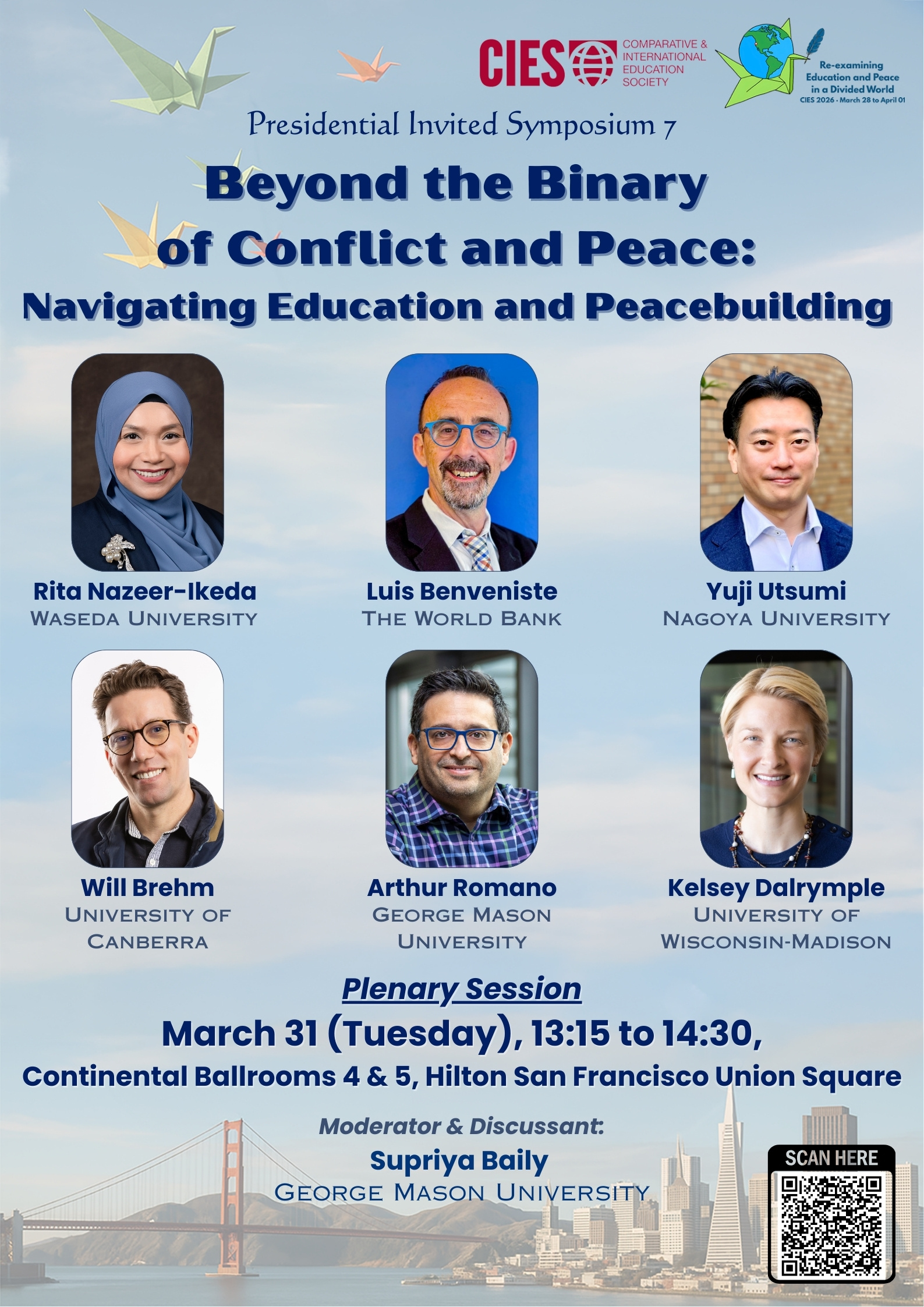
Conflict and peace are often understood through binary and linear frameworks in the field of comparative and international education – education in emergencies versus education for post-conflict peacebuilding, education in fragility versus stability, and education in reconstruction versus development. Contemporary analyses of contextual realities, however, debunk these binaries. They reveal that education operates at the complex intersections of conflict and peace, utilizing mechanisms across spatial dimensions through non-linear, and at times contested, historical narratives.
Discussions in this panel move beyond simple dichotomies by exploring the dynamic multiplicities that shape education for peacebuilding in and across conflict-affected societies. It draws on perspectives from international education, conflict resolution, and peacebuilding, with panelists examining how organizations, systems, and actors navigate the intricate intersections of power, politics, justice, identity, and agency. This symposium argues that education is a dynamic process that resists linear notions of post-conflict-to-peace transitions and embraces plurality, complexity, and coexistence as foundations of sustainable peace.
Invited Plenary Speakers
Rita Z. Nazeer-Ikeda
Unfamiliar Peace: Re(Framing) Education with Reconciliation and Peacebuilding
Dr. Nazeer-Ikeda is a Research Fellow at Waseda University and an Affiliate Faculty at George Mason University’s Carter School for Peace and Conflict Resolution. She began her career as an educator in Singapore and brings over two decades of experience in consulting, capacity building, and community engagement across Singapore, Indonesia, Japan, the United Kingdom, and the United States. Rita’s research focuses on teacher education and education policies in Southeast Asia, with particular attention to decolonization, reconciliation, and peacebuilding.
Luis A. Benveniste
Classrooms for Peace and Prosperity: The World Bank’s Education Programs in Fragile and Conflict-Affected Countries
Dr. Luis Benveniste is the Global Director for Education at the World Bank and former Regional Director for Human Development in Latin America and the Caribbean. A co-author of the World Development Report 2012: Gender Equality and Development, his research focuses on education finance, gender, assessment, and teacher policies. He has led World Bank education projects across multiple regions. Dr. Benveniste holds a B.A. in Psychology from Harvard University and a Ph.D. in International Comparative Education from Stanford University.
Yuji Utsumi
Safeguarding Learning and Building Community Resilience: Lessons from Conflict-Affected Countries
Dr. Yuji Utsumi is an Associate Professor at the Graduate School of International Development, Nagoya University. Drawing on his experience with UNESCO and UNICEF in Afghanistan, Timor-Leste, and Jordan, he uses large-scale quantitative data to study education and armed conflict, school effectiveness, and education sector planning and policy formulation. His recent publications examine the impact of conflict on education access, and the community resilience to maintain education systems. He also consults for ADB and the World Bank on EMIS policies.
Will Brehm
Repatriation or Political Theatre? How the Return of Stolen Artefacts Can Distort History but Support Reconciliation
Dr. Will Brehm is an Associate Professor in Comparative and International Education at the University of Canberra and the Deputy Director of the Centre for Advanced Studies in Education. He is author of Cambodia for Sale (Routledge 2021) and co-editor of Public Policy Innovation for Human Capital Development (APO 2020), Memory in the Mekong (Teachers College Press 2022), and Education and Power in Southeast Asia (Routledge 2023). He is also known for the podcast he created and hosts called FreshEd.
Arthur Romano
Urban Peacebuilding in a Time of Revolt: The Case for City-Wide Learning Systems
Dr. Arthur Romano is an Associate Professor at the Jimmy and Rosalynn Carter School for Peace and Conflict Resolution and is the founder of the Program for Urban Peacebuilding. He brings over 25 years of experience developing innovative, community-based education models in conflict-affected settings. His work centers on urban peacebuilding, nonviolence, restorative justice, and experiential learning. Dr. Romano has collaborated with policymakers, youth leaders, artists, and activists on peace education initiatives in the United States, Nigeria, Nepal, South Korea, and Japan.
Kelsey A. Dalrymple
Beyond the Binary of Healing and Harm: Reimagining Social and Emotional Learning in Crisis Contexts
Dr. Kelsey A. Dalrymple is an educational anthropologist and qualitative methodologist whose research explores decolonizing and alternative methodologies in crisis and displacement contexts. Grounded in critical theory and comparative education, her work examines how crisis-affected communities experience global educational paradigms such as social and emotional learning and trauma-informed practice. With nearly 15 years of experience in Education in Emergencies across Africa, Asia, Europe, and the Middle East, she advocates for equity and epistemic justice in global education research and practice.
Moderator & Discussant
Supriya Baily is Professor and Associate Dean (Carter School for Peace and Conflict Resolution/George Mason University) and former CIES President (2022-2023). She focuses on how structures of power intersect leading to unequal systems of education. Prior to joining academia, she worked for development and social justice organizations leading to her lifelong interest to better understand the processes of agency that promote grassroots transformation in marginalized communities. Her most recent book is Bangalore Girls: Witnessing the Rise of Nationalism in a Progressive City (2024).
| Saturday, March 28 |
Sunday, March 29 |
Monday, March 30 |
Tuesday, March 31 |
Wednesday, April 01 |
|
|---|---|---|---|---|---|
| 11:15 to 12:30 | Kneller Lecture (Plenary) [CIE to Promote Understanding & Peace] |
Keynote Address (Plenary) [Peace Education in Precarious Times] |
|||
| 13:15 to 14:30 | Symposium 2 (Plenary) [Looking Back to Go Forward] |
Symposium 4 (Plenary) [Learning & Its Centrality to Peace] |
Symposium 7 (Plenary) [Beyond the Binary of Conflict & Peace] |
||
| 14:45 to 16:00 | Symposium 3 [Peace as an Ideal for Transforming Education] |
Symposium 5 [Comparative Education, Conflict, & Peace Education] |
Symposium 8 [What Will Be Lost with the Closure of USAID?] |
||
| 16:30 to 17:45 | Symposium 1 [International Preventive Diplomacy as Preventive Education for Peace] |
Symposium 6 [Educating & Organizing for Peace & Justice] |
All plenary sessions are scheduled without parallel concurrent sessions