
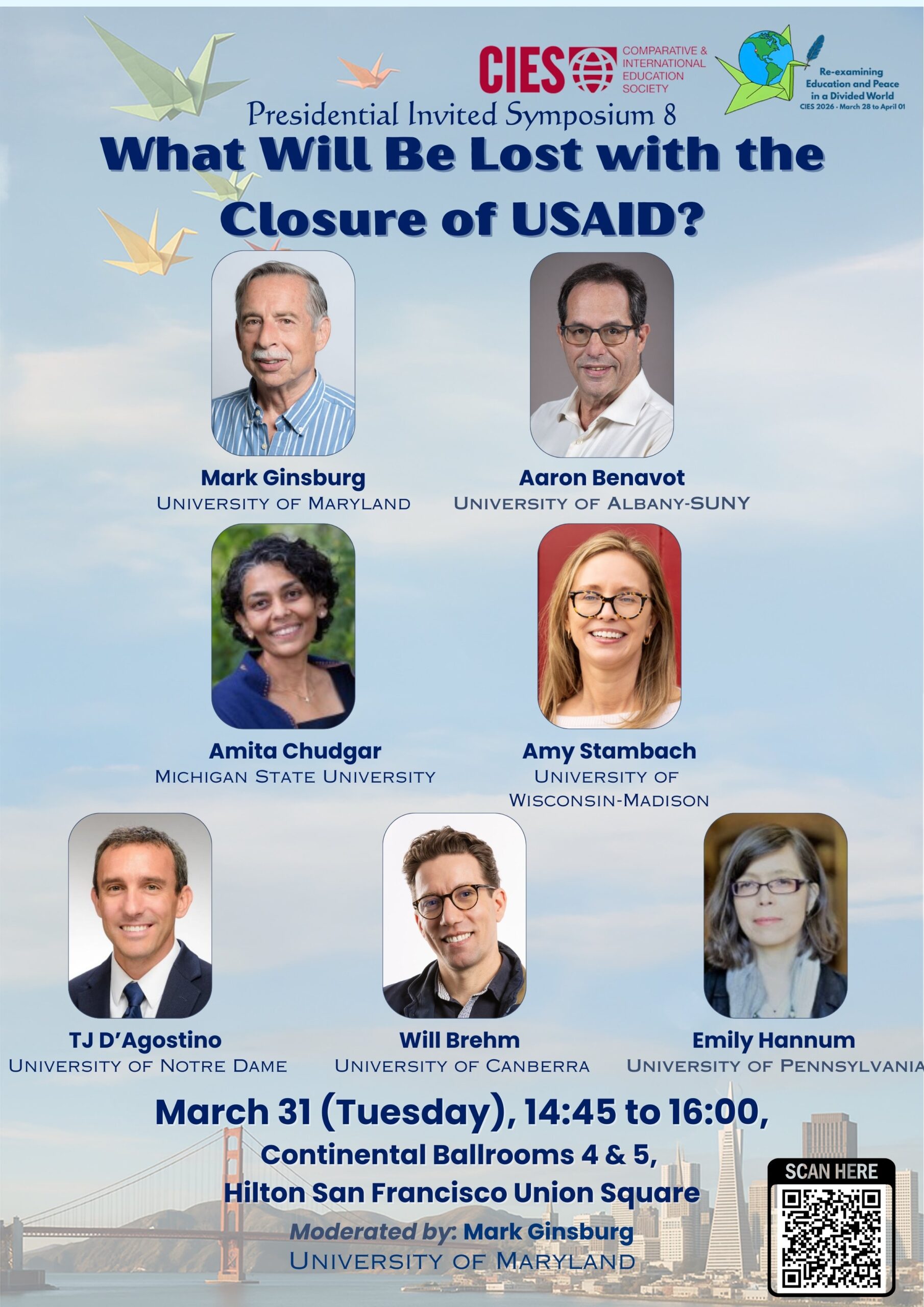
The symposium feature presentations on the history of USAID’s contribution to education between 1961, when it was established, and 2025, when the Trump administration terminated 83% of USAID’s projects and then incorporated the remaining programs into the State Department. Areas discussed include higher education and peace building, preservice and inservice teacher education, and radio and distance education as well as two, major multi-year and multi-country projects – Bridges and the Educational Quality Improvement Programs (EQUIPs). Symposium participants will sketch (in 5-6 minutes each) their documentary research findings, leaving time for those attending the session to ask questions, offer comments, share experiences.
Invited Speakers
Aaron Benavot
Comparing USAID and Other Bilateral Organizations
Aaron Benavot is Professor of Global Education Policy at the University at Albany-SUNY. His comparative research focuses on curricular isomorphism, adult education, global citizenship, and sustainability education. He previously directed the UNESCO Global Education Monitoring Report, an independent, evidence-based publication assessing SDG progress. Since 2020, Aaron has led indicator development work for the MECCE project. Currently he oversees a comparative study of how sustainability/climate change, global citizenship, and gender equality are integrated in curriculum frameworks in primary and secondary education.
Mark Ginsburg
EQUIP’s and Preservice Teacher Education
Mark Ginsburg is a Visiting Scholar in the International Education Policy program at University of Maryland (USA), having been a faculty member at other universities: Houston; Pittsburgh; and Teachers College, Columbia (USA); as well as Aston (England); Oslo (Norway); Kobe (Japan); and Ciencias Pedagógicas “Enrique Jose Varona” (Cuba). He also worked for AED/FHI 360 (2006-2016). Previously, he was C.I.E.S president (1991-1992) and coeditor of the Comparative Education Review (2003-2013).
Amita Chudgar
Inservice Teacher Education
Amita Chudgar is the Associate Dean of International Studies and Professor of Education Policy at Michigan State University’s College of Education. Her long-term research interests focus on ensuring that children and adults in resource-constrained environments have equal access to high-quality education opportunities, irrespective of their backgrounds. Her current work focuses on teacher labor markets in cross-national contexts, and youth education in resource-constrained environments.
Amy E. Stambach
USAID, Higher Education, and the Politics of Peacebuilding
Amy E. Stambach is the Vilas Distinguished Professor of Anthropology at the University of Wisconsin-Madison. Her research examines how community change agents build trust in healthcare, education, and science. Previously, Stambach was a Council on Foreign Relations Fellow, working with USAID. She has also been a Fulbright Fellow in South Africa. Her most recent book is The Corporate Alibi: Capitalism and the Cultural Politics of US Investments in Africa (University of California, 2025).
T.J. D’Agostino
USAID’s contributions to early grade reading and foundational learning
T.J. D’Agostino is a professor in the Pulte Institute for Global Development in the Keough School for Global Affairs at the University of Notre Dame. His work at the intersection of research, policy, and practice in educational development over 20 years has focused on comparative policy, foundational skills, and systems change in low- and middle-income countries. His current research combines rigorous impact evaluations with mixed-methods implementation research studies, informing systems change for improved educational outcomes at scale for marginalized students.
Will Brehm
History of USAID’s Connections with CIE Field
Dr. Will Brehm is an Associate Professor in Comparative and International Education at the University of Canberra and the Deputy Director of the Centre for Advanced Studies in Education. He is author of Cambodia for Sale (Routledge 2021) and co-editor of Public Policy Innovation for Human Capital Development (APO 2020), Memory in the Mekong (Teachers College Press 2022), and Education and Power in Southeast Asia (Routledge 2023). He is also known for the podcast he created and hosts called FreshEd.
Emily Hannum
General Comments
Emily Hannum is Stanley I. Sheerr Term Professor in the Social Sciences at the University of Pennsylvania. Current projects focus on child development in China, the implications of demographic decline for educational systems, and environmental hazards and children’s welfare in China, India, and low- and middle-income countries. She is also collaborating on a project that investigates effects of coeducational and non-coeducational schools on long-term life outcomes in Korea. She co-organizes the Penn Education and Inequality Workshop.
Organizer & Moderator
Mark Ginsburg
| Saturday, March 28 |
Sunday, March 29 |
Monday, March 30 |
Tuesday, March 31 |
Wednesday, April 01 |
|
|---|---|---|---|---|---|
| 11:15 to 12:30 | Kneller Lecture (Plenary) [CIE to Promote Understanding & Peace] |
Keynote Address (Plenary) [Peace Education in Precarious Times] |
|||
| 13:15 to 14:30 | Symposium 2 (Plenary) [Looking Back to Go Forward] |
Symposium 4 (Plenary) [Learning & Its Centrality to Peace] |
Symposium 7 (Plenary) [Beyond the Binary of Conflict & Peace] |
||
| 14:45 to 16:00 | Symposium 3 [Peace as an Ideal for Transforming Education] |
Symposium 5 [Comparative Education, Conflict, & Peace Education] |
Symposium 8 [What Will Be Lost with the Closure of USAID?] |
||
| 16:30 to 17:45 | Symposium 1 [International Preventive Diplomacy as Preventive Education for Peace] |
Symposium 6 [Educating & Organizing for Peace & Justice] |
All plenary sessions are scheduled without parallel concurrent sessions